
Straight Expectations: What does it mean to be gay today?
My book, published in 2014, is free to download for paid subscribers (link below). You might find it interesting to read a take on the topic before the gender wars (although it began for me in 2004)

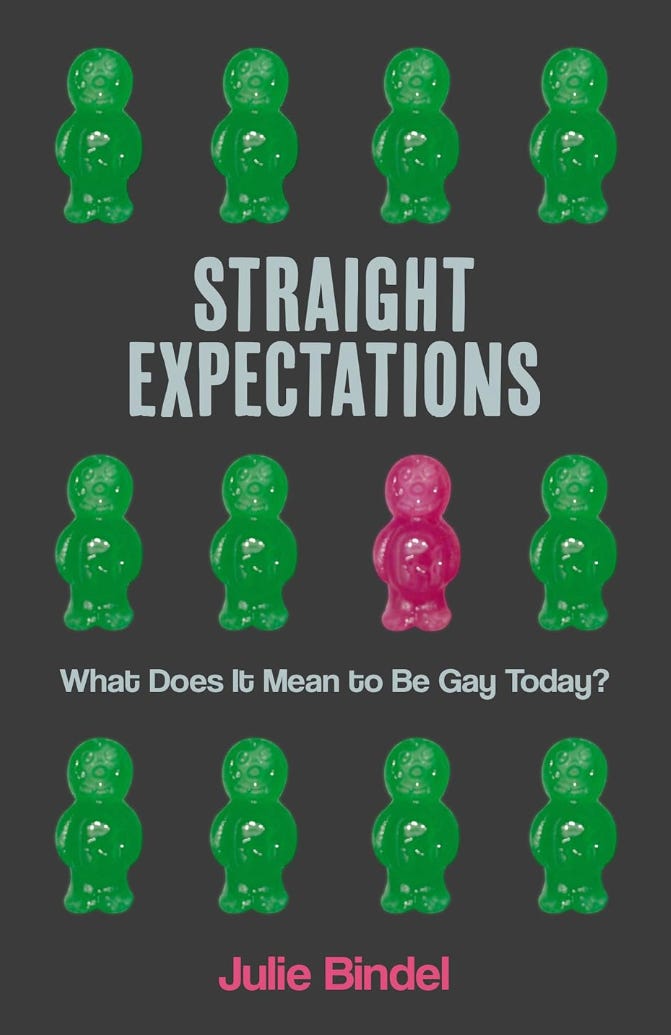
Guardian/Faber, June 2014
*Original blurb
From picket line to picket fence - what does it mean to be lesbian or gay in the era of same-sex marriage and equal rights?
More than four decades after the start of the gay liberation movement, lesbians and gay men can legally marry, adopt children, and enjoy the same rights and respect as heterosexuals ... or can they? In Straight Expectations, Julie Bindel, an out lesbian since 1977, tracks the changes in the gay community in the last forty years and asks whether fighting for the right to marry has achieved genuine progress.
Drawing on extensive original research into changing attitudes towards sexuality, as well as interviews with scientists examining the ‘gay gene’, gay liberation pioneers, religious figures and key players of all political persuasions, Straight Expectations asks:
- Is sexual orientation learned or latent?
- Do lesbians and gay men have anything in common?
- Have we now reached a stage where the ‘only gay in the village’ mentality no longer has any place in society?
CONTENTS
Introduction
Chapter 1: The State of the Nation
Chapter 2: All Het Up: The Bigots
Chapter 3: Is It Something in the Genes?
Chapter 4: ‘Where Are All the Lesbians?’ An Equal Union?
Chapter 5: Mocking the Cradle?
Chapter 6: The Business of Being Gay
Chapter 7: How We Are Gay Today
Conclusion
INTRODUCTION
The past decade has seen a seismic shift in the legislation affecting lesbians and gay men. In March 2014, when this book was written, the first same-sex weddings took place in Britain, nearly 10 years after the passing of the Civil Partnership Act 2004. This means that gay men and women can now marry legally for the first time on British soil and convert civil partnerships into marriages.
Adoption rights have also undergone significant change in the last decade. Prior to 2005 same-sex couples who wished to adopt a child would find themselves in a difficult position, as only one partner was legally entitled to adopt. Not only that but if one half of a lesbian couple used a sperm donor and gave birth to a baby, the other half would have no legal rights unless she was able to adopt the child.
Similarly, if a gay male couple wished to have a baby together, only the partner with a biological connection was recognised as a father.
Thankfully, as we see in chapter 5, legislation relating to the new gay family has now changed for the better.
In July 2010, in another groundbreaking decision, the supreme court ruled that a lesbian or gay person who flees to the UK to escape persecution may be recognised as a refugee if they ‘face a well-founded fear of persecution’ in their country of origin. This is life-altering legislation for lesbians and gay men who flee countries such as Uganda,
Jamaica and Nigeria, and who in the past were routinely refused asylum and disbelieved by the authorities.
There have also been noteworthy cultural changes during the past decade. In 2013 Tatler threw a party to celebrate and ‘normalise’ high-society lesbians. In the same year Olympic medallist Tom Daley announced that he was in a relationship with a man. Suddenly, it seems, homosexuality is ‘fashionable’.
With all these legal and social changes, there is definitely a mood in the UK of exhilaration and victory. Legislatively, nothing now separates lesbians and gay men from heterosexuals. In the space of a few decades it appears we have gone from shame to same. The bigotry of yesteryear, when we were viewed as freaks and corrupting influences, has seemingly been replaced by a seat at the table of normality. When
I tell younger lesbians and gay men what it was like for me as an out lesbian in the 1970s – the threats, assaults, social exclusion and enforced isolation – they tell me how lucky they are that they were born after most of the battle towards full acceptance has been won.
But has it?
However positive these changes are for many lesbians and gay men in the UK today, the fact remains that anti-gay bigotry still rages in the public domain, as witnessed during the parliamentary and media debate on same-sex marriage that has taken place in recent years. In private life, too, there is still a long way to go. As we will learn later in the book, the swath of legislative change does not necessarily reflect shifting cultural attitudes; in some areas, there is still much work to be done. Anti-gay language is rife in schools, and more than half of school-age lesbian, gay or bisexual students have experienced direct bullying.
Hate crime towards lesbians and gay men remains as prevalent as ever, and the closet is still heaving with sporting figures, lesbian actors and folk in small towns and villages across the UK.
In addition, there is also a sense that by gaining legislative rights, we have perhaps lost a part of our gay identity. While it is staggering to look back at the time I came out in 1977, as a 15-year-old, and compare it to today, it is almost more staggering to realise that as well as the pride I feel at being part of a vital gay liberation movement that has achieved huge advances, I also feel a bitter disappointment at how we have lost our way as a community. When I speak to young lesbians and gay men, some in their teens, as I have while researching this book, I marvel at how different their experiences are compared to my own. But even as a young woman, coming out in a climate of hate and prejudice, I never wanted to be ‘like them’. I wanted straight people to see me as a whole human being. My ambition, as a young and passionate lesbian feminist, was to put a rocket up the backside of heterosexuality and to have straight people question the notion of ‘normality’. We wanted to challenge the status quo head-on. For a while we did just that, but in recent years the gay community has gone from being critical of the status quo to begging to be a part of it.
However, when the bigots are gunning against the changes that have enabled lesbians and gay men to marry, join the armed forces, have babies and raise a family, I find myself in an awkward position.
As an out and proud lesbian lucky enough to have a platform from which to speak, I want to use that privilege effectively. I want to say to younger gay people: ‘Look at me. I came out into the most horrendous anti-lesbian bigotry and yet I survived.’ I do not want to then see the confusion and distaste in their eyes as I begin to pull apart some of the so-called gains of the past 40-plus years and denounce them as mere shortcuts to an easier life.
It is extremely challenging to argue a point that you know is radical when parts of it are shared by closed-minded chauvinists with an opposing agenda. When I say that as a feminist, I do not want children, there are always bigots ready to agree with why I should not procreate, confusing my choice with their morality. If I complain that lesbians and gay men should not be joining the unequal and anti-feminist institution of marriage, voices apparently agree that we should not be allowed to. If I proclaim loudly that being a lesbian can be a positive alternative for women who feel trapped by the expectations imposed by heterosexuality, I am told by my gay sisters and brothers that by suggesting we have any control whatsoever over our sexual orientation, I am giving strength to those religious zealots who wish to see us all ‘cured’.
What, as a woman who lives and breathes politics and tends not to follow the party line, do I do now? I write a book. And during the course of writing that book, I seek to listen and learn from those lesbians and gay men with views that oppose mine, to challenge myself and see if I start to shift my opinions from those I began to develop from the time I came out, and in the process hopefully gain a deeper understanding of the values and political strategies adopted by the vast majority.
To do this, I had to ask as many people as possible, both gay and straight, about their lives and beliefs. As well as directly interviewing as wide a range of people as I could, I also disseminated two online surveys.
In total, between August 2013 and October 2013, 5,492 participants completed the survey aimed at those identifying themselves as ‘other than heterosexual’ and 4,036 the one for those who do not identify themselves as lesbian or gay (of which 90 per cent self-identified as heterosexual). From these 9,528 responses – one of the largest surveys of its type – I have been able to gain a broad understanding of modern gay issues and concerns.
This book will examine the contemporary lesbian and gay rights movement and consider how and why it is so fundamentally different from the time I became involved in it, back in the late 1970s. I’ll be looking at such areas as bigotry, the causes of same-sex attraction, the relationship between lesbians and gay men, the rise of alternative families, the interface between capitalism and gay culture, and how far we have come and what still needs to be achieved. I include interviews with some of the key players, references to arguments, theories, ideas and activism, quotes from my extensive surveys and my own personal views and experiences of being an out lesbian for more than three decades. This is not a historical trawl through the gay liberation movement, or a round-up of its significant moments. This book will reflect the lesbian and gay world as seen through my eyes, and, of course, through those of the people who will help to tell my story.
So where does the gay nation stand as we adapt to the changes, challenges and conflicts of this brave new world? How should we react to the evolution of public opinion? What does the future hold for the next generation of lesbians and gay men? And just what does it mean to be gay nowadays? These were the questions I was asking as I set out on my journey to discover the state of the lesbian and gay nation today.
*I have changed my mind on some things since writing this book. And we are now in significantly different times (Julie Bindel, June 2026)
To read the entire book, please take out a paid subscription.
