

Here is the link to my 2022 interview on here, with Mickey, recorded in Ireland
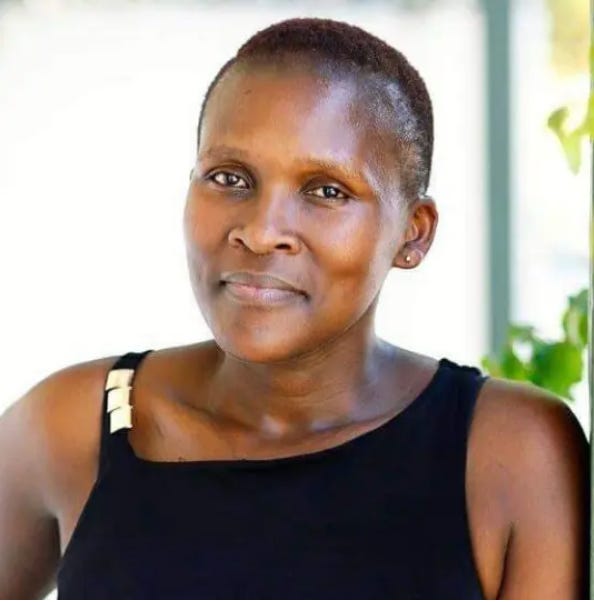
Mickey Meji died today. Her loss is monumental. A black South African feminist, sex trade abolitionist and human rights campaigner, Mickey was caught up in the brutal system of prostitution in South Africa for almost a decade. Soon after she escaped, she shifted to campaign for the introduction of the Nordic Model, a legal framework whereby the prostituted person (almost always women) is decriminalised and helped to exit the sex trade, while the punter/john is criminalised.
At the time I met her, in Cape Town, 2016, Mickey had worked with Embrace Dignity for three years. She had also formerly involved with SWEAT (Sex Workers Education and Advocacy Taskforce), both as a volunteer and as a paid worker.
“Initially when I joined SWEAT it was the only organisation willing to work with women who are prostituted, except they called us ‘sex workers’,” said Mickey. “Since I was on the street and I couldn’t speak with anybody about this, I felt I had found a space for the very first time where I could actually be myself and talk about things I hadn’t talked about with any person.”
She eventually realised that pro-prostitution organisations tend to be led by the available funding rather than concern for those involved in the sex trade. “The big funders are willing to fund decriminalisation of prostitution,” said Mickey, “and the idea that prostitution is simply ‘sex work’. It is not though, it is abuse of women.”
SWEAT is the leading pro-prostitution NGO in South Africa, founded in the early 1990s by two white “sex workers’ rights” activists, Shane Petzer, a gay male sex worker, and Ilse Pauw, a female clinical psychologist. Like other pro-prostitution NGOs, SWEAT uses the international language of human rights to argue for decriminalization.
“I looked at their leaflets,” Mickey told me, “and saw cartoon drawings of happy looking women, and there were [speech] bubbles coming out of their mouths saying things like, ‘My union protects me,’ and ‘I can enjoy my job like anyone else,’ and it made me feel bad for [wanting] to leave prostitution. I thought it must be something wrong with me not to be enjoying it.”
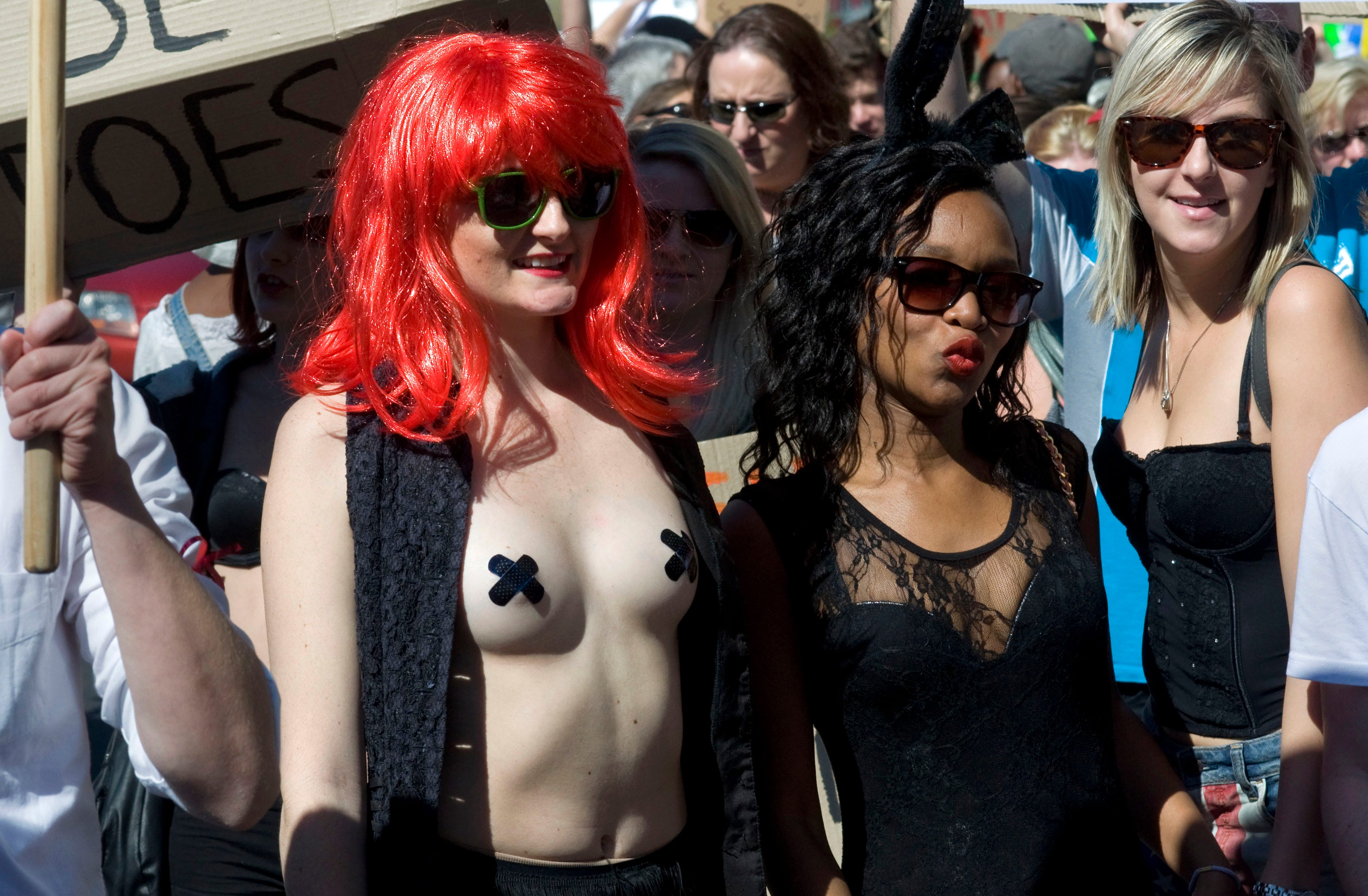
Pro-prostitution activists, Cape Town
SWEAT has been actively campaigning for decriminalization of the sex trade since 2000.
Many of the so-called unions often appear to be set up as worker’s rights organizations in order to look attractive to funders.
I ask Mickey whether she believes it is possible to unionize the sex trade. “No,” she said, “because in South Africa the trade unions that we have, as far as I am concerned, represent people who are recognized as workers.” Mickey was referring to domestic workers in South Africa, who are often ill-treated, underpaid and abused by employers, and, until the early 2000s, had no employment rights.
“People can unionize before they are legally recognized as workers,” she told me. “We started having ‘house helps,’ and the employers decided what they wanted to pay and they [workers] decide if they want to accept it. Finally, through unionizing, they fought for the recognition of their rights. It was not a criminal offence to be ‘house help.’ That’s the difference; otherwise we’ll start having a union of smugglers and traffickers.”
What if prostitution was legalized? No, she always maintained. Mickey firmly believed that the stigma of being prostituted will always be felt by the women, even if there are no criminal penalties attached. “How do you unionize people in their absence?” she asked. “When they march they wear masks; they want to be hidden and anonymous. How do you then unionize that? Because every industry that we know of, regardless of how gruesome it is or how dirty it is, people have taken ownership. But in the sex trade there is no real ‘pride’ from the women being prostituted.”
I visited her at Sistahood – a support group for women wishing to leave the sex trade, set up by Embrace Dignity. Mickey stood by a whiteboard, scrawling random words and sentences shouted out by the 20-plus women sitting around a large table. “Prostitution must fall”, “Education must rise”, and “Women and girls and not for sale”.
In 2025, I interviewed Mickey for what would be the final time, to ask her about the growing threat of laws that would result in blanket decriminalisation of its entire sex trade, making it the first African country to do so. Thanks to the international movement of abolitionists, this did not happen. Mickey was pivotal in the fight.
“When I say that I imagine a world without prostitution, I am treated as though I am saying we can do without air, or water,” she said. “But who does prostitution serve? Not the women, who are doing this out of desperation, often with a violent pimp behind her, but the men that abuse us for their own selfish pleasures.”
Mickey spoke eloquently about how racist the system of prostitution is, and would point out the hypocrisy of white liberals, claiming to be anti-racist and at the same time referring to prostitution as “sex work”.
“It is impossible to divorce our history of apartheid and racism with the way black women are treated in the sex trade, because this is a form of slavery – dehumanising women so they can be bought and sold for the pleasure of men.”
As a member of SPACE International, an NGO led by women that have exited the sex trade, Mickey regularly travelled the world to meet with other survivors and activists pushing back against decriminalisation. “The exploiters, not the women, should pay the price of prostitution,” she always said.
According to Mickey, there is a network of over 40 organisations supporting decriminalisation across South Africa, which includes every single one of the LGBTQ+ organisations. At first glance, this could be because they share the same funding streams with HIV prevention services aimed at gay men, because prostituted women are also a high risk group. But the theory, promoted in 2014 by the medical journal The Lancet, that global decriminalisation significantly reduces new HIV infection rates has been debunked. The researchers failed to take account of the fact that the prostitution market spirals under decriminalisation and legalisation.
South Africa is still, in this respect, operating as an apartheid state, with the poorest black women and girls being coerced into prostitution to meet the desires of wealthier men, who are often white.
In a podcast interview we did together, in Dublin, 2022, I asked about SWEAT, and how they have managed to convince so many citizens that decriminalisation would make it safer for the women:
“In my nine years in the streets, I don’t know of a woman who was murdered by police officers, but I know plenty murdered by pimps and sex buyers,” she replied. “So why then does SWEAT campaign to end the stigma on men that pay for sex?”
She spoke of talking to members of the Nelson Mandela government who said that he was always very keen to eradicate prostitution because he could see it was happening to the poorest black women, largely by white men.
When I last met Mickey, in 2022, she’d just arrived back from a three-day holiday break in the southwest of Ireland that she’d taken with her dear friend, sex trade abolitionist and founding member of SPACE International, Rachel Moran. I asked Rachel what she had to say about Mickey’s passing. She said, “Her death leaves an empty space in the movement and in my life that nothing and no one will ever fill. I’ll miss her forever.”
Ohhh god. I remember her speaking at a SPACE International event at Conway Hall in the spring of 2019, called Women of Colour Against the Sex Trade. I remember her harrowing testimony, along with the other women who spoke: Dr Vednita Carter and Suzanne Jay being 2 of the others. I was shaken to my core by it. It was a window into the hell experienced by prostituted women. I hope her soul can fly free of all that now. May she rest in peace and in the knowledge she won’t be forgotten.
i will send this related book free to anyone who wants https://www.amazon.co.uk/Diary-High-Risk-Lifestyle-Kay-Buckingham/dp/1804397954